See what exists. Control what changes.
First establish what is there. Then decide what should change. Inspect the plan, verify the result, and preserve a portable DEX artifact where supported—without making a central service the source of truth.
Understand what is intended, inspect it before execution, verify artifact integrity, and preserve a portable record of the process—without making a central service the source of truth.
Security Begins with a Plan.
Information should not be changed on faith alone. Dennis separates the intended operation from execution, so a supported change can be inspected and validated before it is applied. Each domain still requires appropriate controls, testing, and operational procedures.
Plan Before You Change
Dennis generates a deterministic transformation plan before modifying your project. The plan describes what will happen before anything happens.
See What Will Happen
Inspect the transformation before execution. Nothing happens behind your back, and the plan itself becomes the source of truth.
Verify Before You Apply
Validate the plan, verify its integrity, and apply it only when you're satisfied with the result.
Built Around Information Integrity
Dennis is built around a simple idea: information operations should be predictable, inspectable, and independently verifiable wherever the workflow and its implementation support those guarantees.
Deterministic
The same input produces the same output. Reproducibility is built into the core of Dennis, not added as an afterthought.
Inspectable
Nothing happens behind your back. Plans can be reviewed, verified, and understood before they are applied.
Portable
Transformations become artifacts. Store them, version them, share them, and use them wherever you need — without depending on a central service.
Two complementary engines. One protocol.
Dennis combines state discovery with controlled information transformation. They can work together, but each is useful on its own: sometimes the goal is to understand and document what exists; sometimes it is to transform supplied information through a reviewable process.
1. Discovery & State Reconstruction
Scan a supported target and create a structured picture of its current state. Use that baseline to inspect content, compare states, identify differences, and understand what is present before deciding what to do next.
Core capability: Inventory · State capture · Structural analysis · Comparison
2. Controlled Information Transformation
Define an intended operation, generate an inspectable plan, validate it, and apply supported changes deliberately. Where supported, preserve the operation and its result in a portable DEX artifact for later review and verification.
Core capability: Planning · Transformation · Validation · DEX artifacts · Reproducibility
From discovery to controlled transformation
A common path is to inspect a target, understand its state, plan a supported change, review and verify the plan, apply it, and preserve the result. Discovery does not have to lead to a transformation, and supported transformations can also work from supplied inputs.
1. Scan
Examine the source material and identify the content relevant to a supported operation.
2. Plan
Generate a deterministic plan describing the intended operation and its changes.
3. Inspect
Review the plan before execution. Understand the intended operation before it happens.
4. Verify
Validate the plan and verify its integrity before applying the operation.
5. Apply
Execute the operation only when the plan has been reviewed and accepted.
6. Pack
Preserve the operation as a portable DEX artifact that can be stored, shared, and reviewed later.
Preserve the Process as a DEX Artifact
An important information operation should leave more than an unexplained result. DEX artifacts preserve a portable, inspectable representation of a deterministic transformation, including its plan and metadata, so it can be reviewed, verified, shared, and retained.
Portable
DEX artifacts are files. Store them locally, keep them in Git, share them with a team, or publish them through an artifact registry.
Inspectable
A DEX contains a human-readable transformation plan together with its metadata. You can inspect what the artifact represents without relying on a hosted service.
Verifiable
Deterministic contents can be hashed and verified. Optional cryptographic signatures can provide additional evidence of provenance and integrity.
Reproducible
Because the artifact represents a deterministic transformation, it can be preserved and reproduced independently of the machine that created it.
Welcome to the Forge
The Dennis CLI provides the processing engine. Forge provides a place to store, organize, discover, and share DEX artifacts as part of a broader information-integrity workflow.
Store Your Artifacts
Upload DEX artifacts and keep them organized in one structured environment instead of scattered across machines, folders, and chat messages.
Organize Your Work
Use Workspaces and Projects to give related artifacts a meaningful home and keep complex transformation work organized as it grows.
Collaborate
Share artifacts with the people who need them. Private, organization, and public visibility let you control who can see your work.
Discover & Inspect
Search and inspect artifacts through the hosted Forge while keeping the underlying DEX files portable and independent.
Preserve Trust
Artifacts remain immutable. The Forge indexes their metadata and provides the surrounding infrastructure without changing the artifacts themselves.
Never Get Locked In
Your artifacts remain yours. Export them, preserve them locally, and continue using them with the Dennis CLI without depending on the hosted platform.
One Integrity Model. Many Applications.
Dennis is an information security protocol built around deterministic processing plans, inspectable changes, and portable artifacts whose integrity can be verified. Software transformation is its most mature application today. Structured-document extraction is experimental, while legal/notarial and forensic workflows remain exploratory and require domain-specific controls, validation, and integrations.
Software Developers
Plan and review code refactors, migrations, and internationalization work before applying changes. Preserve the transformation as a portable artifact that teammates can inspect and verify.
Established focus: software transformation workflows.
Structured Documents
Experimental extractors collect eligible strings from HTML, Microsoft Word DOCX, and LibreOffice ODT into structured JSON with source context. Extraction is read-only; it does not yet promise full document round-tripping.
Experimental: document extraction tools.
Legal Offices & Notaries
A potential foundation for controlled document-processing workflows where changes need to be reviewed and preserved. Domain-specific templates, compliance rules, and legal workflow integrations require further development.
Exploratory: not a legal-practice or case-management system.
Forensics & Law Enforcement
Deterministic processing plans and verifiable artifacts may support repeatable, reviewable evidence-processing procedures. Specialized forensic integrations and validated chain-of-custody workflows are not yet provided by the core.
Exploratory: integrity checks alone do not establish evidence authenticity.
Education & Research
Teach reproducible transformations, inspectable plans, and artifact-based workflows. Students and researchers can examine what a transformation intends to do instead of treating it as an opaque script.
Current focus: reproducible learning and research workflows.
Auditable Team Workflows
Share DEX artifacts that describe intended changes. Review plans before execution, verify artifact integrity, and use optional cryptographic signatures where an additional trust layer is needed.
Core capability: inspectable, portable transformation artifacts.
Choose the Forge That Fits You
Start with the free Forge and grow when your work demands more. Paid plans add storage, privacy, collaboration, and organizational capabilities — not artificial restrictions on Dennis itself.
Free
Start exploring the Forge and working with public artifacts.
- 100 MB storage
- Public artifacts
- Community support
- CLI forever
Basic
For individual developers who need private artifact storage and signing.
- 1 GB storage
- Private artifacts
- Artifact signing
- Email support
Pro
For developers and professionals managing larger collections of artifacts.
- Everything in Basic
- 10 GB storage
- Organizations
- Advanced permissions
- Storage add-ons
Team
For teams that need shared workspaces, collaboration, and room to grow.
- Everything in Pro
- 5 GB storage per user
- 30 GB shared Team storage
- Team workspaces
- Collaboration
- Priority support
Enterprise
For organizations requiring dedicated infrastructure, support, or agreements.
- Unlimited organizations
- Dedicated support
- Custom onboarding
- Self-hosted options
- Enterprise agreements
Every Forge Plan Includes the Core
Forge can grow with your work without changing the core protocol principles. Your DEX artifacts remain portable, inspectable, and yours.
DEX Artifacts
Work with deterministic artifacts designed to be inspected, verified, preserved, and shared.
Projects & Workspaces
Organize related artifacts into meaningful projects and workspaces as your work grows.
Control & Integrity
Keep control over artifact visibility and work with an infrastructure designed around integrity and predictable behavior.
Keep Your Artifacts
Your DEX artifacts aren't trapped inside the Forge. Export them and continue working with the Dennis CLI whenever you want.
The Dennis Forge Bookshelf
Dennis Forge is not only about software. The DEX artifacts and the stories built around them are part of the same universe — knowledge preserved in a form that can be shared, inspected, and remembered.
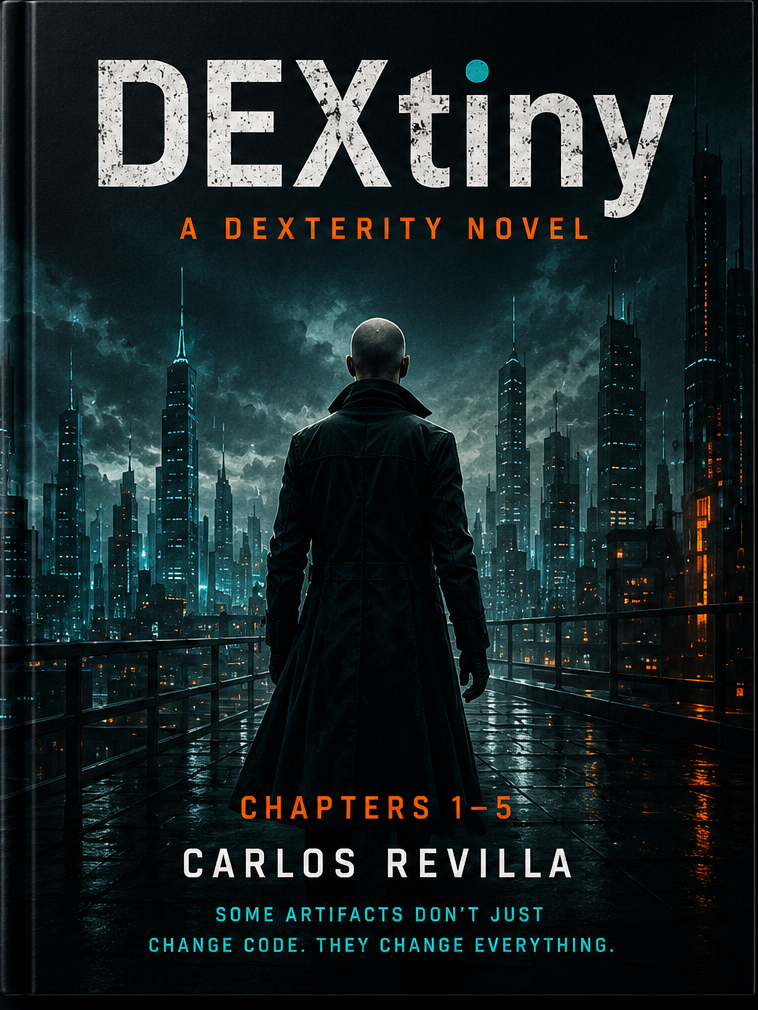
DEXtiny
A DEXterity novel. The first five chapters introduce Mateo, Annika, Navarro, and the mystery surrounding a seemingly ordinary DEX artifact.
Chapters 1–5 are now available. Pay what you wish, with a minimum contribution of US $0.50, and receive the PDF by email after payment confirmation.
Build the Future of Verifiable Information
Dennis also supports people learning, teaching, and researching reproducible information workflows, with software transformation as the most mature current application.
Students
Learn deterministic software transformation using the same tools and concepts used throughout the Dennis ecosystem.
Educators
Bring reproducible transformation workflows into your courses, labs, and software engineering projects.
Research Institutions
Explore deterministic transformations and artifact-based workflows in research environments.
Become a Forge Founder
Before there was a community, before there were thousands of artifacts, there were the people who believed early.
Founder memberships. No more. No less.
The first 161 people who choose to support Dennis become part of its permanent history as Forge Founders.
Founders receive lifetime benefits, special recognition, and a place in the Hall of Founders.
And because Dennis should leave the world a little better than it found it, 15% of every Founder membership is donated: 10% to UNICEF and 5% to childhood cancer research.
Ready to Forge?
Start with the free Dennis CLI, create your first deterministic artifact, or join the Forge and begin building a workflow around it.
Free forever. Open source. Deterministic by design.
Building Something Bigger
Dennis Forge is more than a software project. It is also a way to give something back.
Children's Health
A portion of Dennis The Forge revenue is donated to charitable organizations, including UNICEF and organizations supporting cancer research and children's health. Semestral donation reports and receipts will be published for transparency.
Education & Opportunity
We believe knowledge should be accessible and that technology can create opportunities for everyone.
Giving Back
Dennis Forge pledges to dedicate part of its revenue to causes that matter beyond software.
You don't need Dennis Forge to help make a difference. If these causes resonate with you, you can also support them directly:
Donation Appreciation Discount
Helping others deserves a little something in return.
Send us proof of a donation of at least US $20 to UNICEF or St. Jude Children's Research Hospital and receive a 25% discount on any Dennis Forge plan. (Terms apply)
Terms & Conditions
- Minimum donation amount: US $20.
- Valid for donations made to UNICEF, St. Jude Children's Research Hospital, or any verified non-profit organization working to make the world a better place.
- Approved donations grant a 25% discount for three consecutive billing cycles.
- Proof of donation and, when applicable, proof of the recipient organization's non-profit status may be required.
- Only one donation discount may be active per customer account at any given time.
- After a donation discount expires, a new approved donation may qualify the customer for another discount period.
- The discount cannot be combined with Founder memberships or other promotional offers.
- Dennis Forge reserves the right to reject unverifiable submissions or organizations that do not meet the spirit of this program.